<img height="1" width="1" style="display:none;" alt="" src="https://px.ads.linkedin.com/collect/?pid=9446764&amp;fmt=gif">
SoloTruth Asset Relationship Management

The Orchestration Layer Between Your Assets, Your Workforce, and Your ERP

SoloTruth Asset Relationship Management (ARM) is the orchestration layer between your assets, your workforce, and your ERP. It schedules, delegates, escalates, and approves at scale so your asset register reflects physical reality every day, not just on audit day.

Companies with $100M in fixed assets can generally expect a less than 6-month payback on their ARM investment based on more accurate asset records across depreciation, tax, insurance, audit, and capital allocation. 1

1 Based on SoloTruth ARM ROI Calculator.

SoloTruth
Proven platform foundation
Axon Ivy
Universal Orchestration engine

IoT Evolution World 2026 Asset Tracking Award

Continuous verification requires orchestration. Orchestration requires a purpose-built layer.

Every organization with significant fixed assets has the same operational problem: someone needs to know, every day, which assets are where, in what condition, and whether the ERP matches physical reality. At scale, that is a workflow problem before it is a technology problem.

An inspection app captures data. RFID tags locate assets. Your ERP records the outcome. None of those systems orchestrates what happens between capture and record. ARM does. It schedules who inspects which assets, routes exceptions to the right person, enforces approval before any ERP update, and keeps a timestamped audit trail of every decision.

Your ERP is a system of record. SoloTruth is a system of proof. ARM does not replace your ERP. It proves whether what your ERP says is true, every day, not just on audit day.

Fixed asset records drift from physical reality. The consequences compound.

Asset records are accurate the day they are created. After that, physical reality and the ERP record diverge. Most organizations have no systematic way to detect it, and no governed mechanism to correct it.

Without ARM
Ghost assets inflate the register Assets scrapped, moved, or stolen remain on the books, generating phantom depreciation and distorting capital allocation.
Depreciation schedules are wrong Records for assets that no longer exist or have been significantly modified continue to drive tax and book depreciation calculations.
Year-end reconciliation is a fire drill Physical inventory audits happen once a year. Discrepancies surface too late and require expensive, manual remediation to clean up before the audit window closes.
No audit trail for ERP changes When records are corrected, there is no defensible record of who approved the change, based on what evidence, and under what authorization.
With ARM
Ghost assets are identified and resolved Physical evidence capture continuously surfaces assets that no longer match their ERP record. Each discrepancy is routed through a governed resolution workflow before any record update.
Depreciation reflects physical reality Records are updated continuously as assets change state. Tax and book depreciation calculations are based on accurate, evidence-backed data.
Audit-ready always, not just at year-end Continuous reconciliation means the records are clean before the auditor arrives. There is no year-end scramble. The evidence is already there.
Every ERP update is defensible ARM enforces a governed approval workflow before any ERP record change. Every update is traceable, logged, and backed by physical evidence.

Inaccurate fixed asset records are a finance and control problem, not an operations problem

Record drift reaches every corner of the balance sheet. Finance leaders who have run a fixed asset reconciliation almost always find the exposure larger than expected.

Audit and SOX Exposure

Inaccurate fixed asset registers create material weakness risk under SOX. Auditors increasingly flag subledger accuracy as a control deficiency, and the exposure compounds when there is no audit trail for how records were corrected.

Tax and Depreciation Distortion

Ghost assets keep generating tax depreciation deductions for assets that no longer exist. This distorts the effective tax rate and creates reconciliation risk with tax authorities. Defensible depreciation schedules require a clean register.

ERP Migration Risk

Fixed assets are consistently the most problematic dataset in ERP migration post-mortems. Inaccurate records entering a migration multiply remediation cost and extend the timeline. Clean the register before the project starts.

Inflated Property Tax Assessments

Property tax is assessed on reported asset values. Ghost assets inflate the taxable base. Organizations that have never reconciled their register frequently discover significant overpayment when they finally do.

Capital Allocation Errors

Capital planning made on inaccurate asset records produces systematic errors. Organizations over-invest where they think assets are depleted and under-invest where utilization is higher than the register shows.

CSRD and Sustainability Reporting

CSRD requires asset-level data for emissions and lifecycle reporting at county-level geographic precision. Organizations without a reliable fixed asset register cannot meet that standard without a reconciliation project first.

Request a Free ROI Working Session

We will work through our ARM ROI model with your actual asset base. You leave with a custom estimate of your ghost asset exposure across eight cost categories, including phantom depreciation, property tax, insurance, and audit labor. No commitment required. The model is yours to keep.

Request a Free ROI Working Session

Continuous asset verification driven by your own workforce

Traditional fixed asset audits rely on expensive third-party accounting firms running annual point-in-time reviews. By the time the report is filed, the register is already drifting. ARM replaces that model entirely. It deploys the people already closest to your assets, the forklift driver, the maintenance technician, the plant floor supervisor, to verify asset condition and location continuously, as part of normal operations. ARM manages the workflow: who verifies what, when, what to do when something is wrong, who approves the fix, and when the ERP updates. No annual audit required.

1
Schedule

ARM assigns verification tasks by asset type, location, and cadence. The right person gets the right task at the right time, no coordinator required. Verification happens as part of normal operations, not as a separate audit event.

2
Assign

Tasks are routed to the workforce member already closest to the asset. A forklift driver verifies warehouse equipment during their shift. A maintenance tech confirms condition during a service visit. No separate audit team. No travel. No delay.

3
Capture

The assigned worker captures condition, location, and documentary evidence via mobile, RFID, or GPS, directly from the field. Every submission is time-stamped and tamper-evident. The evidence is automatically compared against the ERP record, with discrepancies surfaced immediately.

4
Escalate

Missing assets, condition changes, location mismatches, and document discrepancies are automatically escalated to the right person with a tracked resolution path. Exceptions do not sit in a spreadsheet. They move through a defined workflow until resolved.

5
Approve

Human sign-off is required before any discrepancy is written back to the ERP. Every approval is logged with the approver's identity, the supporting evidence, the policy applied, and the timestamp. Nothing changes without authorization, and every authorization is auditable.

6
Update ERP

Approved findings update the fixed asset register. No manual data entry. No unreviewed changes. Every ERP update is backed by a complete chain of evidence: who captured it, who approved it, under what policy, and when. When the auditor arrives, the record is already defensible.

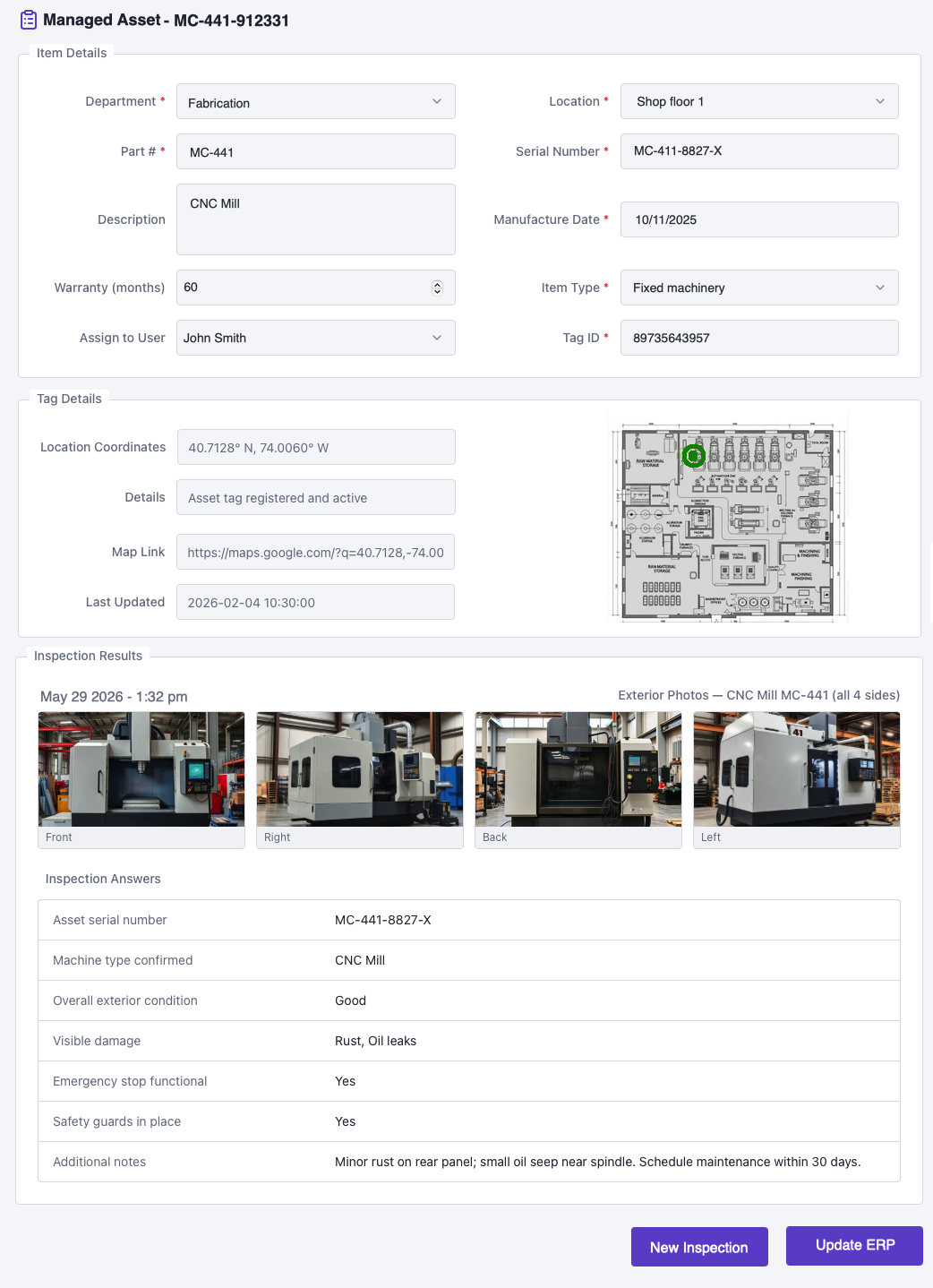
SoloTruth ARM dashboard, inventory item detail view

Enterprise-grade orchestration.

ARM is built on Axon Ivy's Universal Orchestration architecture. Gartner rates Universal Orchestration a HIGH innovation benefit and projects 90% enterprise adoption by 2029 (G00841113, February 2026).

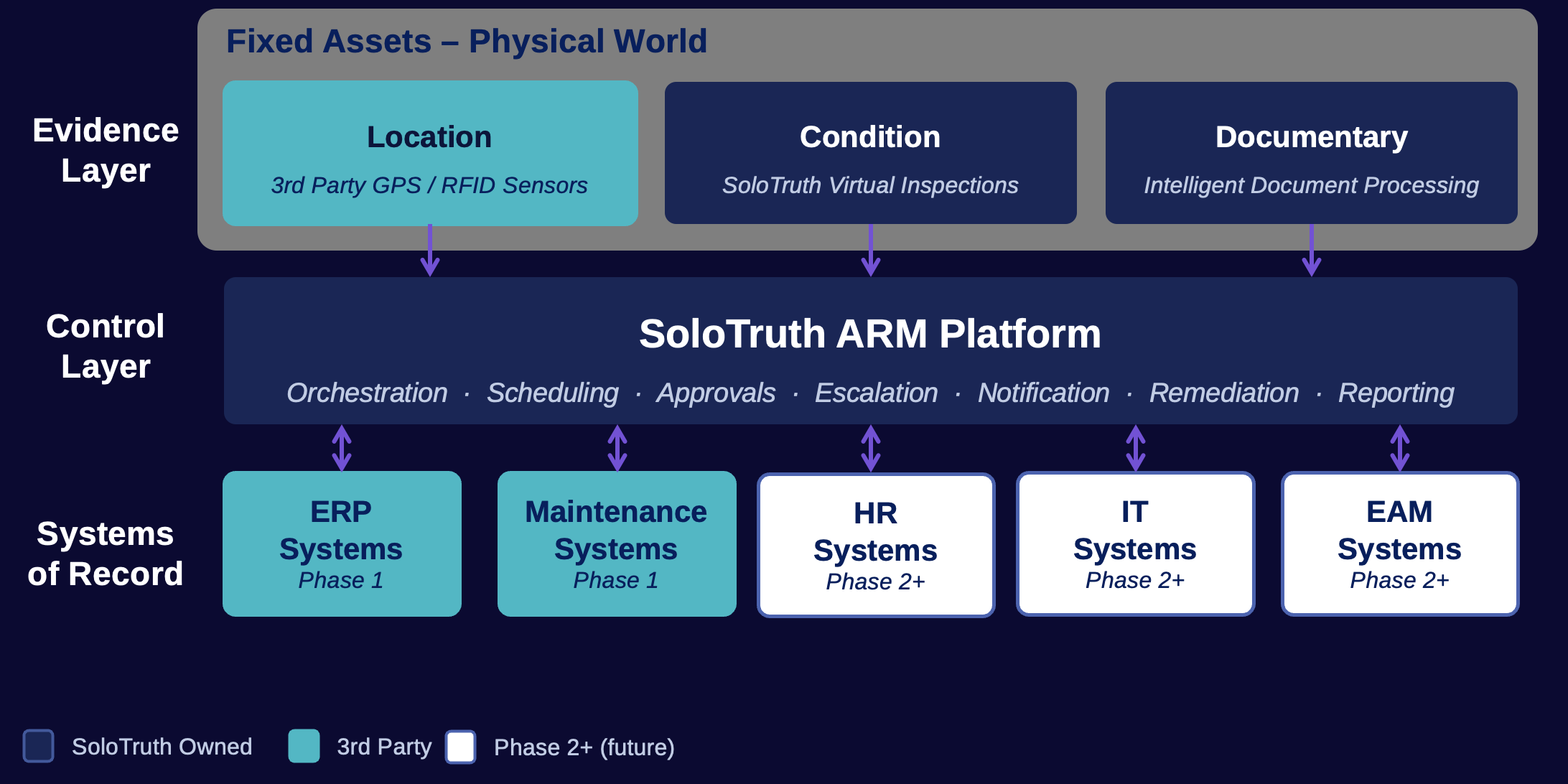
SoloTruth ARM extends the proven evidence capture and workflow engine already behind VirtuSpect, adding RFID and GPS location intelligence, AI-powered document processing, ERP synchronization, and the full Axon Ivy Universal Orchestration control layer to close the loop between physical reality and the financial record.

SoloTruth ARM Platform Architecture

Powered by Axon Ivy Universal Orchestration. Every approval, escalation, notification, and ERP update in ARM flows through Axon Ivy's enterprise-grade orchestration engine. Policy-based. Fully auditable. Proven at enterprise scale across global manufacturing, financial services, and technology sectors.

1,000+
Inspections orchestrated on the VirtuSpect platform
~4 days
Loan closing acceleration at Celtic Bank
HIGH
Gartner innovation benefit rating for Universal Orchestration (G00841113)
90%
Projected enterprise adoption of Universal Orchestration by 2029
New application. Proven foundation.

The ARM platform is battle tested and built to scale

ARM extends the same evidence capture, workflow orchestration, and audit-ready evidence model already powering SoloTruth VirtuSpect in production at commercial banks including Celtic Bank, Bankwell, and CCBank.

The capture layer, the mobile evidence workflows, the governed review and approval engine, and the audit retention infrastructure are all proven. ARM applies that foundation to the fixed asset reconciliation problem.

When you adopt SoloTruth ARM, you are not betting on an unproven architecture. You are extending a platform that has already completed over 1,000 inspections in regulated financial environments, powered by an orchestration engine trusted by Airbus, ERGO, and Bauer.

Download the One-Pager

Prefer to reach us directly?

info@solotruth.com

Physical evidence captured at the asset, not approximated in a spreadsheet

Field teams, facilities staff, or authorized site personnel use the SoloTruth mobile app to capture geo-tagged, time-stamped evidence for each asset. Guided workflows ensure nothing is missed. RFID and GPS data layer in automatically where hardware is deployed.

Evidence is tied to the specific asset record in real time. There is no batch upload, no manual matching, and no reconciliation lag. By the time a discrepancy reaches the finance team, the physical evidence is already attached.

Everything needed for continuous fixed asset accuracy

Guided mobile asset evidence capture
RFID and GPS location tracking
AI-powered document processing (IDP)
ERP fixed asset register reconciliation
Ghost asset identification and resolution
Axon Ivy Universal Orchestration workflow engine
Policy-based approval and escalation routing
Controlled ERP update with full audit trail
Continuous reconciliation, not periodic cleanup
Depreciation and tax record accuracy
Long-term evidence retention
Audit-ready reporting and export

See ARM in the context of your asset environment

The best next step is a demo/discovery call so we can understand your unique requirements and show you how ARM's evidence capture, reconciliation, and governed workflow model applies to your fixed asset environment.

Whether you are preparing for an ERP migration, addressing an audit finding, or simply trying to understand how bad the ghost asset problem actually is, that conversation is where we start.

Organizations that have never done a systematic fixed asset reconciliation routinely uncover ghost assets on the books. Kroll Advisory reports that 10% to 30% of assets on the average fixed asset register no longer physically exist. The financial exposure is almost always larger than expected.

Request a Call

A member of our team will follow up shortly.