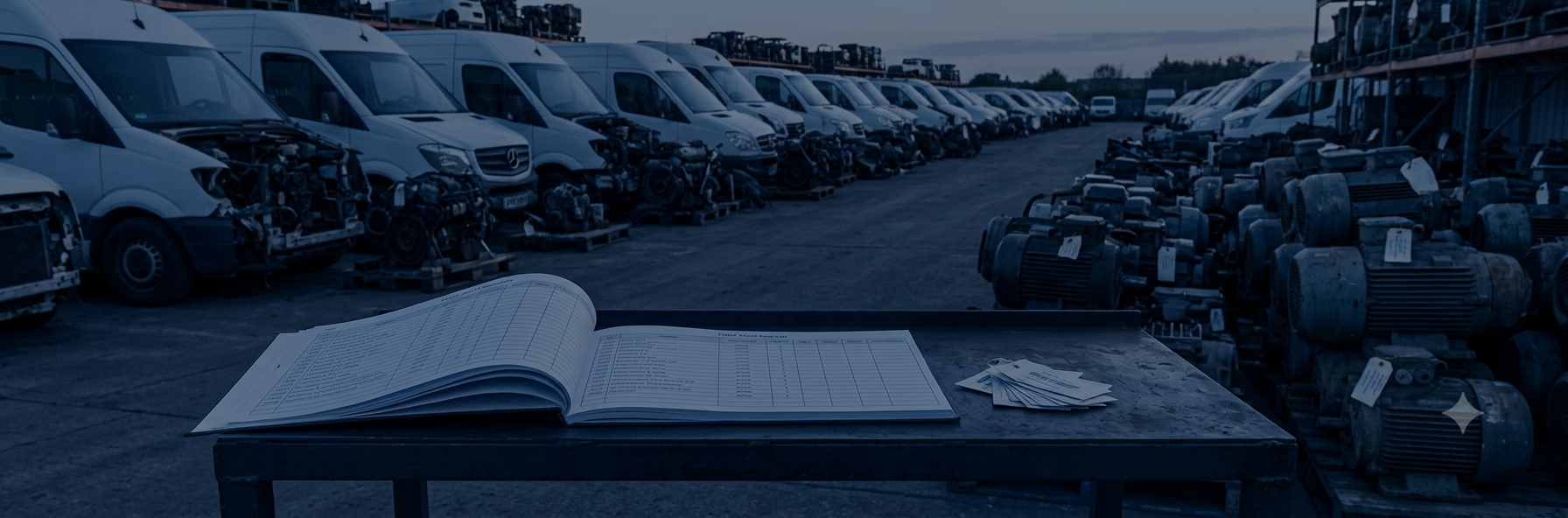
Ghost assets are fixed assets that stay on the fixed asset register after they have physically left service. They keep drawing depreciation, sit inside insured values and tax filings, and overstate what a company owns. Most enter the register through six ordinary field events that never reach accounting.
Ghost assets rarely arrive through fraud or a single large mistake. They arrive one field event at a time: a truck written off after an accident, a tool scrapped at a job site, a pump moved to another plant, a motor replaced during a shutdown. Each event changes the physical estate. None of them changes the record unless someone passes it along.
The scale can be material. Kroll reports that its Fixed Asset Register Health Check found more than 15 percent of recorded assets were no longer in service at one manufacturing client. Auditors are paying closer attention too. PCAOB's 2024 inspection data shows long-lived assets became the number one ICFR audit deficiency area, even as overall audit quality improved.
This post is for fixed asset managers, controllers and audit teams who want to know where their own ghost assets come from, and what catches each kind.
What Is a Ghost Asset?
A ghost asset is an asset that was real, was recorded on the fixed asset register, and has since left service without the register being updated. The record survives the asset.
That definition matters because it separates ghost assets from two problems that often get lumped in with them. A duplicate record or a typing error never corresponded to a real piece of equipment, so it is a data quality problem, not a ghost asset. The opposite failure also has its own name. Zombie assets are in service in the field but missing from the register entirely.
Ghost assets are the overstatement side of fixed asset verification. Auditing standards treat them under the existence assertion, which tests whether recorded assets actually exist. Zombie assets fall under the completeness assertion, which tests whether everything that should be recorded is recorded. They are separate tests because sampling what is on the books cannot tell you what is missing from it.
A typical example starts during a maintenance shutdown. A crew replaces a worn motor on a conveyor line and scraps the old one. The work order closes and the maintenance system shows the repair. The fixed asset register still carries the original motor at its original cost, and depreciation on it keeps running for years.
The costs of a ghost asset are quiet. Depreciation keeps running, so the income statement carries expense for equipment that no longer contributes. Insured values include it. Property tax filings may still list it. And because nothing in the ledger looks wrong, no one investigates until a count, an audit or a claim forces the question.
Why Ghost Assets Happen: The Six Mechanisms
Every ghost asset starts with a physical event that the fixed asset register never hears about. Six mechanisms account for the ones that matter.
- Disposed but never retired on the books: Equipment is scrapped, sold, cannibalized or written off after damage, and the disposal never reaches the fixed asset team. This is the most familiar mechanism. It usually happens because the person who disposes of the asset works in operations, not accounting.
- Lost or stolen: A tablet goes missing from a service truck, or a generator walks off a site. To a field verification, a lost asset and an undocumented disposal look identical: recorded, not found. Only an investigation can tell them apart.
- Transferred without documentation: A pump moves to another plant, or test equipment moves to another yard. The asset still exists, but the register places it somewhere it is not. Location-based charges, property tax jurisdiction and custodian accountability all go wrong at once.
- Fully depreciated but still listed: An asset reaches zero book value and drops off everyone's radar. It then leaves service without a retirement entry because no one sees a financial reason to record one. It still inflates asset counts, insured values and, in some jurisdictions, property tax listings.
- Replaced components, the partial ghost: Under IAS 16 paragraphs 43 to 47, significant components of an asset are depreciated separately. When a component is replaced during maintenance without a matching entry, the parent record keeps depreciating something that no longer exists. Standard ERP maintenance workflows make this easy to miss, because the maintenance system records the repair and the fixed asset subledger never hears about the part that came out.
- The like-kind swap: A serialized, reusable asset leaves the site and a physically identical unit comes back in its place. The count reconciles perfectly, quantity out equals quantity in, but the register is now wrong at serial level. Acquisition date, cost, accumulated depreciation and remaining life all attach to the wrong unit.
Periodic Counting vs. Continuous Verification
|
|
Periodic physical count |
Continuous verification |
|
When changes are found |
Once a year, or less |
When the field event happens |
|
Disposed and lost assets |
Found if the count is complete |
Flagged at the next field touch |
|
Undocumented transfers |
Found only if the counter checks location |
Location confirmed on every capture |
|
Replaced components |
Rarely checked at component level |
Captured with the maintenance work |
|
Like-kind swaps |
Invisible when totals reconcile |
Caught by serial-level identity |
|
Audit evidence |
A count sheet and a date |
A record of each event and who approved it |
The Real Cost of Ghost Assets
A ghost asset costs money in five places, and none of them shows up as a line called ghost assets.
- Depreciation on equipment that is gone: The expense keeps running on the income statement. With replaced components, depreciation keeps running on something that no longer exists.
- Tax treatment that depends on the recorded retirement: Group depreciation is a financial reporting convention. It does not govern the tax treatment of a disposal. Unless the taxpayer has made a general asset account election, an unrecorded retirement can leave an asset depreciating for tax after it is gone, and can forgo a deductible abandonment loss.
- Insured values built on a stale record: In a 2026 Marsh poll, 59 percent of risk and finance professionals said they were unsure when their assets were last independently valued, had not valued them recently, or relied on estimated values.
- Audit exposure: Existence testing is designed to catch overstatement, and ghost assets are overstatement by definition. When an auditor samples the register and cannot find what it lists, the finding lands on the fixed asset team.
- Regulatory consequences when it goes far enough: Hertz paid a $16 million SEC penalty in 2019 for vehicle fleet accounting errors, including physically damaged vehicles that were never written off the books. The company overstated pretax income by $235 million across multiple periods. It was an accounting misstatement case, and it shows what a disposal that never reaches the ledger can become at scale.
"Ghost assets aren't the problem. The annual audit cycle is. Ghost assets are just what happens when you only look once a year."
Tim Harris, CEO, SoloTruth
Who Is Most Affected?
Any organization with a large, distributed physical estate accumulates ghost assets, whatever its industry. Exposure rises with the number of locations, the rate of change in the field and the distance between the people who handle equipment and the people who record it.
- Fixed asset managers in manufacturing and heavy industry: Maintenance shutdowns replace components constantly, which makes partial ghosts a routine outcome rather than an exception.
- Controllers at fleet-heavy businesses: Vehicles get totaled, cannibalized for parts and swapped between depots. Every one of those events needs a retirement or a transfer entry.
- Finance teams at logistics and distribution companies: Handhelds, containers and material handling equipment move between sites daily, and pooled reusable assets are exactly where like-kind swaps happen.
- Regulated utilities: Plant accounting teams file depreciation studies with state commissions, so a register carrying equipment that has left service feeds directly into the lifespans a regulator approves.
- Internal audit teams: Existence and completeness are separate assertions, and a register with unrecorded retirements fails the first one quietly.
What to Look For in a Solution
Not every approach to ghost assets catches all six mechanisms. When evaluating options, look for six capabilities:
- Serial-level identity, not just counts. A method that reconciles totals will never see a like-kind swap. Each asset needs to be confirmed as the specific unit on the record.
- Condition capture at the point of work. The people who retire, repair and move equipment are the ones who can record the event. Capture should happen during work they already do, not in a separate annual exercise.
- Location evidence from multiple sources. GPS, RFID, barcode scans and field confirmation each catch transfers the others miss. Single-source location data leaves gaps an auditor will find.
- Component-level tracking tied to maintenance. When a work order replaces a significant component, the replaced part should leave the record and the new one should enter it.
- Human review before the register changes. Every finding should be reviewed and approved by accounting before it reaches the system of record, with the approver and the evidence recorded.
- A write-back to the existing ERP. Verified changes should flow into the fixed asset module the company already runs, so the ERP stays the system of record and no one re-keys a journal entry.
What Good Looks Like
Companies that keep ghost assets under control share a handful of habits. None of them depend on a bigger annual count.
- Retirement is triggered by the field event, not by the calendar: A disposal in operations starts the retirement workflow the same day, instead of waiting for a count to discover it.
- Every asset class has an owner of the handoff: Someone is accountable for passing each type of field event to accounting, and everyone knows who that is.
- Zero book value does not mean zero attention: Fully depreciated assets stay in the verification scope until they are physically confirmed as retired.
- Maintenance and fixed asset records talk to each other: Component replacements on work orders flow to the fixed asset subledger as partial retirements and additions.
- Verification confirms identity, location and condition together: A single field touch answers all three, so the record reflects what the asset is, where it is and what state it is in.
Common Misconceptions About Ghost Assets
Three beliefs keep ghost assets on registers longer than they should be.
Misconception: The annual physical count catches ghost assets.
Reality: A count catches assets that are missing when it is taken. It does not catch a like-kind swap, it rarely checks components, and everything that changes after count day waits a year to be found.
Misconception: A fully depreciated asset has no financial impact.
Reality: It may carry no book value, but it can still inflate insured values, asset counts and some property tax listings, and its eventual retirement may carry tax consequences.
Misconception: Data entry errors are a kind of ghost asset.
Reality: A ghost asset must once have physically existed and been recorded. A duplicate or mistyped record never matched a real asset. It is a data quality problem with a different fix.
Frequently Asked Questions
What is a ghost asset in accounting?
A ghost asset is a fixed asset that remains on the fixed asset register after it has physically left service. It continues to draw depreciation and inflate reported assets until someone records its retirement.
How do ghost assets get onto a fixed asset register?
Through six field events: disposals that are never retired, lost or stolen assets, undocumented transfers, fully depreciated assets that leave service, replaced components, and like-kind swaps of serialized equipment.
What is a partial ghost asset?
A partial ghost is a replaced component that stays on the register. Under IAS 16, significant components are depreciated separately, so a replacement without a matching entry keeps depreciation running on a part that is gone.
Can a physical count find every ghost asset?
No. A count finds assets that are missing on count day. It cannot detect a like-kind swap, where totals reconcile but the serial numbers on the record no longer match the equipment.
What is the difference between a ghost asset and a zombie asset?
A ghost asset is on the register but gone from the field. A zombie asset is in service in the field but missing from the register. They are tested under different audit assertions.
Why do fully depreciated assets become ghost assets?
Once book value reaches zero, no one sees a financial reason to record a retirement. The asset leaves service quietly, but it can still affect insured values, counts and some tax filings.
How often should fixed assets be verified?
Verification should follow field events, not just the calendar. An annual count confirms one point in time, while continuous verification records retirements, transfers and component changes when they happen.
Ghost Assets Start in the Field, So Verification Has to Start There Too
Every one of the six mechanisms begins with a physical event that the fixed asset register never hears about. A bigger annual count finds some of them late and misses the like-kind swap entirely.
The fix is a record that updates when the field changes, backed by evidence an auditor can follow.
This is the gap SoloTruth's Asset Relationship Management platform (ARM) was built to close. ARM verifies the existence, location and condition of physical assets through field inspections by a company's own teams, RFID and GPS data, and document intelligence, then reconciles that evidence with the ERP after accounting approves each change.
Book a 30-minute strategy call at calendly.com/tim-harris-solotruth/30min to see how continuous verification changes what your fixed asset register is actually capable of.
Last Updated: September 2026