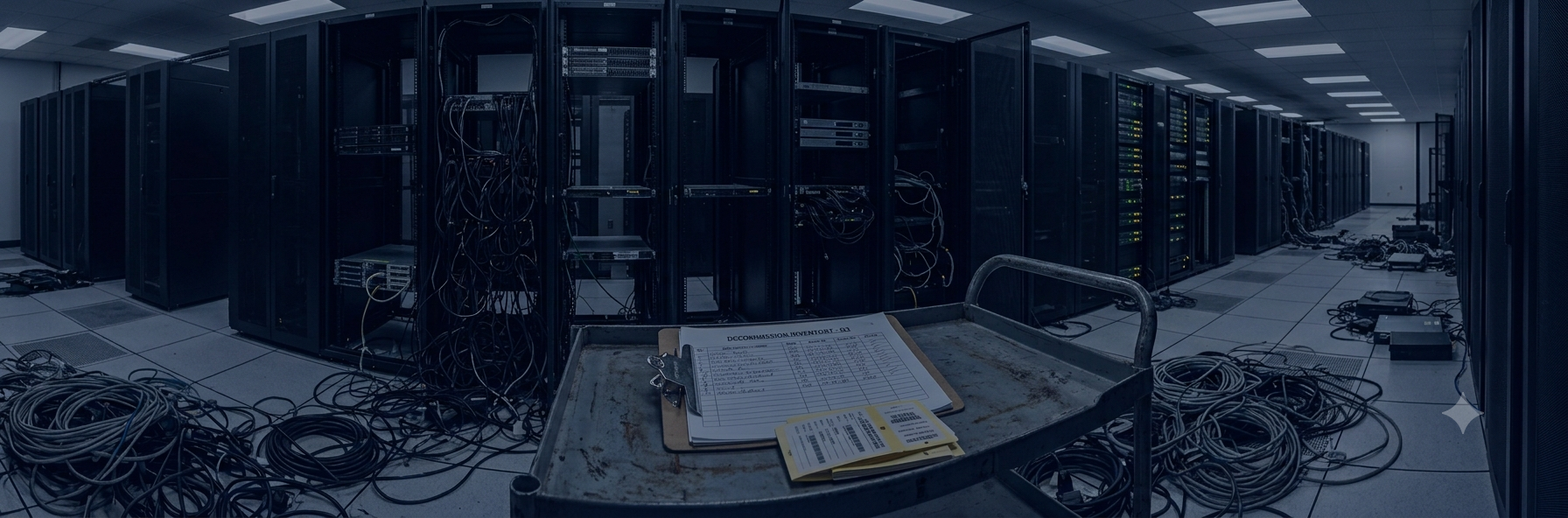
A fixed asset data migration is the process of carrying an asset register from one ERP platform to another, exactly as recorded. It reconciles what is loaded against what is loaded, not against physical reality, so any asset already missing, mismatched, or long retired moves forward unchanged and unquestioned.
Roughly 17,000 SAP ECC customers have not yet migrated to S/4HANA, and SAP’s own mainstream maintenance window on ECC ends December 31, 2027. For CFOs, controllers, and IT asset managers running SAP today, that date is no longer a planning horizon. It is a forcing function. Every asset record currently sitting in ECC, accurate or not, is about to make a one-way trip onto a new platform, and almost nothing about that trip checks whether the record was ever true in the first place.
What Is a Forced ERP Migration Deadline?
A forced ERP migration deadline is the point at which a vendor stops supporting the platform a company runs on, requiring the company to move its data to a new system on a fixed timeline rather than one of its own choosing.
SAP set that timeline for ECC customers at December 31, 2027, when mainstream maintenance ends. Gartner’s widely reported projection puts roughly 17,000 SAP customers as not yet migrated to S/4HANA as of this writing, which means a large population of finance and IT teams are now working backward from a date that was not theirs to negotiate.
The asset register is one of the things that has to make that trip. Every fixed asset record, every depreciation schedule, every location and condition field, gets carried from the old system into the new one. A migration project is built to move that data faithfully. It is not built to ask whether the data was accurate on the day it moved.
Why Data Quality Problems Surface During a Migration
Data quality problems do not start with the migration. They start years earlier, in the gap between an annual physical count and everything that happens to an asset in between. A migration simply forces everyone to look at the register at once, on a deadline, which is exactly when the accumulated drift becomes visible and expensive.
- Migration tools reconcile the load, not the world. SAP’s own documentation describes a physical inventory process ordered by a director and carried out by a commission, someone still has to walk the floor first. Oracle states plainly that you must take physical inventory of your assets before its Physical Inventory feature can do anything with the result. The reconciliation step confirms the system matches what was entered. It does not confirm what was entered matches the asset.
- The annual audit cycle already let drift accumulate before the migration was ever scheduled. A fixed asset register that gets checked once a year has roughly 364 days between checks for reality to move without anyone updating the record. By the time a migration date lands, that drift has had years to compound, not months.
- Migration timelines crowd out data quality work. Horvath Partners, in a study of 200 transformations, found that roughly 65% exceeded budget or schedule, and separately, 65% reported significant data quality deficits in the result. The study’s cited leading causes were scope expansion, project management gaps, and underestimated testing and data migration, not a single dominant factor. Data quality work competes for the same calendar as testing, cutover planning, and everything else a migration has to finish on time.
- Nothing was built to catch new drift before the migration started. Most companies enter a migration with no standing process for routing a floor observation, a retirement, a relocation, into the register between counts. The migration does not create that gap. It just makes the gap visible on a date everyone is already watching.
One-Time Pre-Migration Cleanse vs. Continuous Verification
|
|
One-Time Pre-Migration Cleanse |
Continuous Verification |
|
Frequency |
Once, ahead of cutover |
Ongoing, before and after cutover |
|
Evidence quality |
Point-in-time snapshot |
Current as of the last observed change |
|
Audit readiness |
Accurate on cutover day only |
Accurate on any day it is checked |
|
Post-migration accuracy |
Degrades starting the week after go-live |
Maintained on the new platform the same way it was on the old one |
The Real Cost of Migrating Bad Asset Data
A migrated ghost asset is still a ghost asset. It just arrives on the new platform with a clean audit trail behind a fact that was never true.
- Depreciation accuracy: a record carried forward inaccurate stays inaccurate, now inside a system everyone assumes was cleaned up as part of the move.
- Audit exposure: an internal or external auditor testing the post-migration register inherits every pre-migration gap, with a fresh system in front of it to make the gap harder to trace.
- Property tax filings: a filing built on the migrated register carries forward whatever the register said, whether or not the underlying asset still exists in that condition or location.
- Insurance schedules: coverage set against a migrated asset list reflects what the list says, not what is actually running or sitting idle on the floor.
“SoloTruth is built on a simple reality: systems of record describe what should be true about a company’s fixed assets, but don’t consistently prove what is true. Asset data inevitably drifts after purchase, relocation, refurbishment, and handoffs across teams and vendors.”
- Tim Harris, CEO, SoloTruth
Who Is Most Affected?
- CFOs and controllers at SAP ECC shops: the migration deadline forces a data conversation onto their calendar whether or not the underlying asset register was ever a priority before.
- IT and ERP program leads running the migration: they own a project scoped around moving data on time, not around independently verifying it, and inherit the consequences either way.
- Internal audit teams: a freshly migrated system does not reset the audit trail. Every pre-migration gap in existence or completeness testing carries forward with it.
- Manufacturing, logistics, and industrial companies with large physical asset counts: the more physical assets on the books, the more surface area for the register to have drifted from the floor before the migration ever started.
What to Look For in a Migration Data Quality Approach
Not every approach to pre-migration data quality actually closes the gap between the register and the floor. When evaluating options, look for six capabilities.
- Direct ERP reconciliation so verified asset data flows into the new platform without a manual journal entry or spreadsheet handoff at cutover. A handoff step introduces exactly the kind of error the migration is supposed to eliminate.
- Continuous evidence capture rather than a single pre-migration count. A cleanse that happens once, before cutover, tells you nothing about the week after go-live.
- Multi-source evidence combining physical inspection, location data, photos, and document extraction. A single source of evidence leaves the same kind of gap an auditor will eventually find.
- Orchestrated workflow governance that routes a discrepancy to the right reviewer automatically, rather than depending on someone remembering to raise it during an already compressed migration timeline.
- Human-in-the-loop remediation at the specific points where a person has to confirm a correction before it posts, not just observe that a discrepancy exists.
- Audit-ready output with a documented evidence chain per asset, not a single count or summary report, so the trail survives the platform change intact.
What Good Looks Like
- Start the data quality conversation before the migration is scheduled, not once the project plan is already locked and testing has claimed most of the calendar.
- Treat the pre-migration cleanse as a floor, not a finish line. It buys accuracy on cutover day. It does not buy accuracy on the days after.
- Build the routing path before go-live, so a floor observation reaches the register the same way on the new platform as it should have on the old one.
- Name a reviewer for every category of correction, so a discrepancy found mid-migration has a defined person confirming it, not a generic queue.
- Keep the evidence chain intact across the platform change, so an auditor can trace a corrected record back to what triggered the correction, not just to the date it was entered.
Common Misconceptions About Migration Data Quality
Misconception: "Our systems integrator’s data cleansing workstream already covers this."
Reality: It covers what is visible on the day of cutover. Nothing about a one-time cleansing pass builds a path for the next observation, retirement, or relocation to reach the register once the project team moves on.
Misconception: "SAP’s physical inventory feature will catch data errors during migration."
Reality: SAP’s own documentation requires a physical inventory to be carried out by a commission before the feature can reconcile anything. The tool confirms what you loaded matches what you loaded. It does not go looking for what you never entered.
Misconception: "The Horvath data quality finding means budget overruns are a data problem."
Reality: Horvath Partners reports two separate findings, roughly 65% of transformations exceeding budget or schedule, and, separately, roughly 65% reporting data quality deficits. The study’s own stated leading causes of the overrun are scope expansion, project management gaps, and underestimated testing and migration phases, not data quality itself.
Frequently Asked Questions
What happens to bad asset data during an ERP migration?
It moves with everything else. A migration reconciles the record you load against itself, it does not independently confirm the record matches the physical asset, so inaccurate data typically arrives on the new platform unchanged.
When does SAP ECC mainstream maintenance end?
SAP ECC mainstream maintenance ends December 31, 2027. Gartner’s widely reported projection puts roughly 17,000 SAP customers as not yet migrated to S/4HANA as of this writing.
Does a pre-migration data cleanse fix asset data accuracy permanently?
No. A cleansing pass fixes what is visible on the day it runs. Nothing about a one-time pass builds an ongoing path for new observations to reach the register after cutover.
Can SAP or Oracle’s physical inventory features catch asset data errors on their own?
No. Both vendors document that a physical inventory must be carried out by a person or team before their reconciliation features can do anything with the result. The software reconciles the count. It does not perform the count.
Why does asset data drift even between annual counts?
Assets move, get repaired, get retired, and get replaced continuously, while most fixed asset registers only get checked once a year. The gap between what changed and what got recorded compounds every year nobody closes it.
Is a forced migration deadline a bad time to fix asset data quality?
No. It is one of the few moments finance, IT, and operations are already looking at the same asset data at once, which makes it a comparatively cheap time to build a path for that data to stay verified going forward.
The Deadline Forces the Cleanup. It Does Not Fix the Process.
SAP ECC customers now have a fixed date forcing a decision they might otherwise have deferred indefinitely. That is useful. A mandated migration gets everyone looking at the asset register at the same time, which rarely happens otherwise.
What it does not do on its own is build a lasting path for asset data to stay accurate once the migration is finished. This is the gap SoloTruth Asset Relationship Management (ARM) was built to close. ARM verifies the existence, location, and condition of physical assets continuously and reconciles that evidence directly into the ERP you run, before and after a platform change.
Book a 30-minute strategy call at calendly.com/tim-harris-solotruth/30min to see how continuous verification changes what your asset register is actually capable of carrying into a migration, and keeping accurate after.
Last Updated: August 2026