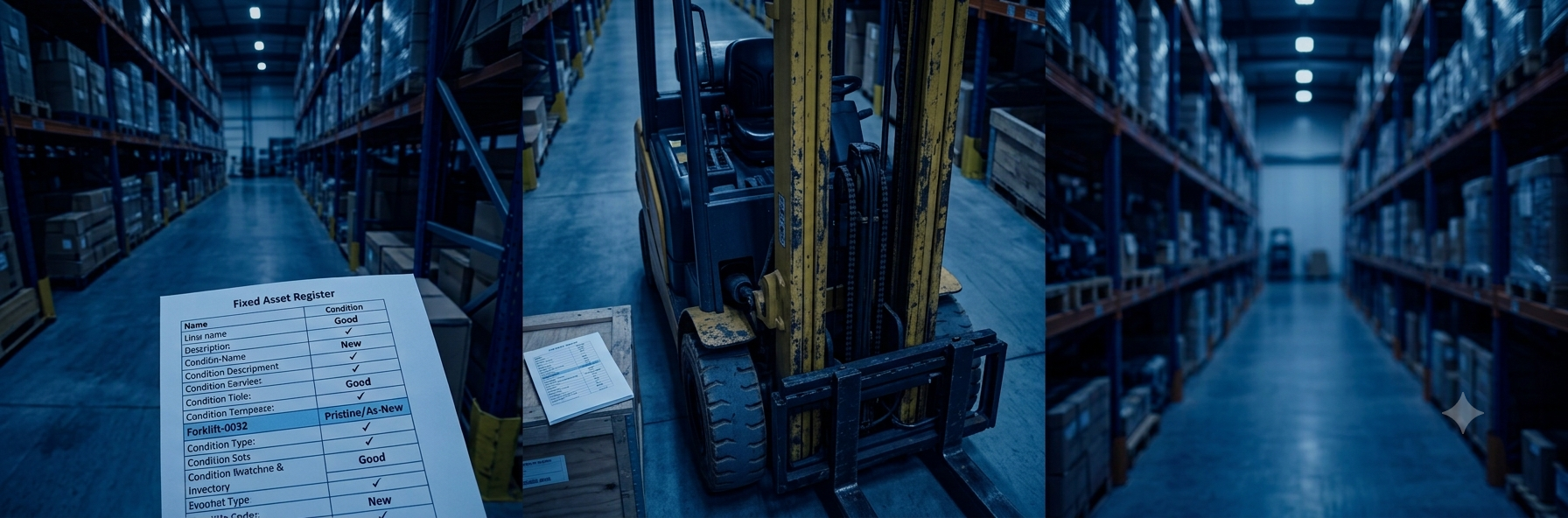
A fixed asset register is the running list of everything a company's books say it owns, including each asset's condition and location as of the last time anyone updated it. It reflects a snapshot, not the asset's condition right now. Between updates, the person operating that asset every shift already knows more about it than the register does.
Manufacturing plants, warehouses, and distribution centers run on equipment that changes condition constantly: wear, minor damage, drift, quiet repairs nobody logs anywhere central. Kroll's advisory data puts a number on the resulting gap: up to 65 percent of fixed asset records contain errors, missing data, or information that is already out of date by the time anyone reads it. Fixed asset managers, controllers, and plant operations leaders inherit that gap every reporting period, usually without knowing which specific line items are wrong until an audit, an impairment test, or a physical count finds out the hard way. The information that would have caught the drift earlier already exists. It's standing next to the asset.
What Is the Operator Knowledge Gap?
The operator knowledge gap is the distance between what a fixed asset register says about an asset and what the person running it already knows, a gap that opens the moment the register was last updated and widens every day after.
Most companies don't think of it as a gap at all, because nobody framed it that way. The register gets updated on its own schedule: a purchase, a disposal, an annual count, an audit finding. The person who operates the asset, meanwhile, notices things continuously and has nowhere defined to put that knowledge.
Consider a forklift operator running the same unit every shift for a year. She notices the mast lifts slower than it used to. She notices a new hydraulic drip last Tuesday. She notices the wheel bearing has started to make a sound it didn't make last month. None of that is a mystery to her. All of it is completely invisible to the fixed asset register, which still shows the unit at its original purchase condition until the next scheduled inspection, whenever that happens to fall.
- A maintenance technician who services three sites knows which building's HVAC units are running past their expected condition curve, long before a formal inspection catches up to that building.
- A warehouse floor supervisor knows which racking has taken impact damage this quarter, because she walked past it.
Why the Gap Happens
The gap isn't a diligence failure on anyone's part. It's structural.
- The register only updates on defined events. A purchase, a disposal, a journal entry, a scheduled count. An observation that something changed isn't one of those events, so it doesn't trigger anything.
- There's no defined path for a floor observation to travel. An operator can mention what she noticed to a supervisor, or not. If she does, whether it goes anywhere depends entirely on whether the supervisor remembers, has time, and knows who to tell.
- Periodic counts assume the register is right in between counts. Nothing about an annual or quarterly cycle checks that assumption while the clock is running. Drift compounds quietly the whole time.
- Verification gets treated as an audit function, not an operations one. The people asked to verify assets are usually not the people who spend the most time with them. The people who spend the most time with them are rarely asked.
Annual Count vs. Operator Knowledge
|
|
Annual or Periodic Count |
Operator Knowledge |
|
Frequency |
Once or a few times a year |
Every shift |
|
Who observes |
An auditor or inspector, often unfamiliar with the specific asset |
The person who runs it daily |
|
Evidence timing |
Weeks or months after a change occurs |
The day it happens |
|
Register accuracy |
Degrades steadily between counts |
Stays current, if the observation is captured |
The Real Cost of the Operator Knowledge Gap
- Depreciation schedules run on stale condition data. An asset degrading faster than its useful-life assumption keeps depreciating on the original schedule until someone catches the mismatch.
- Impairment triggers get missed. ASC 360 requires impairment recognition when evidence shows carrying value exceeds fair value. If the evidence sits in an operator's memory instead of a record, the trigger never fires on time.
- Maintenance and PM plans get built on the wrong assumptions. A preventive maintenance schedule based on the register's condition data, rather than the floor's, plans around a version of the asset that no longer exists.
- Audit exposure widens. When a register entry can't be traced to recent, first-hand evidence, an auditor has no way to confirm it beyond taking the number on faith.
"Your ERP is updated by accountants once a year. Your assets move every day. That's the gap."
— Tim Harris, CEO, SoloTruth
Who Is Most Affected?
- Plant and operations leaders in manufacturing and warehousing: They manage the people with the most current asset knowledge in the building, with no defined way to get that knowledge into a financial or maintenance record.
- CFOs and controllers in asset-intensive industries: They inherit whatever the register says at close, with no visibility into how many observations never made it there.
- Internal audit teams: They find the gap after the fact, during testing, when a sampled asset's real condition doesn't match what the register shows.
- Maintenance and reliability managers: They plan preventive maintenance against a register that may be describing a version of the asset that no longer exists.
What to Look For in a Solution
Not every approach to asset verification accounts for the knowledge the floor already has. When evaluating options, look for six capabilities:
- A reporting path built for the person on the floor, not just for auditors conducting a scheduled count.
- Confirmation before anything counts. A named reviewer signs off before an observation changes the register, so a floor report becomes governed evidence, not a rumor.
- Timestamped capture at the moment of observation, not batched into the next scheduled inspection.
- Routing to the right reviewer by asset type or exception severity, so an observation doesn't sit waiting for whoever happens to be free.
- A retained record that an observation happened, whether or not it changed anything, so nothing depends on someone remembering a hallway conversation.
- A direct connection to the register, so a confirmed observation updates the record without a manual handoff that can get dropped.
What Good Looks Like
- Reporting a condition change takes less effort than staying quiet about it. Friction is the reason most observations never get made at all.
- Every observation carries a timestamp and a name, whether or not it ends up changing anything.
- A defined reviewer confirms the observation before the register changes, so the operator's knowledge becomes accountable evidence instead of an informal aside.
- The same observation serves both operations and finance. A condition flag that helps maintenance plan a repair is the same event that updates the register's condition data, not two separate processes on two separate schedules.
- Nothing depends on a supervisor remembering to bring it up in a meeting.
Common Misconceptions About the Operator Knowledge Gap
Misconception: Our supervisors already talk to the floor, so we already capture this.
Reality: A verbal mention isn't a governed record. It has no timestamp, no confirmation step, and no trace if the supervisor forgets or moves to a different role.
Misconception: Operators aren't trained to assess asset condition, so their observations aren't reliable enough to use.
Reality: An operator doesn't need to render a formal condition score. Noticing that something changed and flagging it is enough to trigger a review. Expertise gets applied at the confirmation step, not the observation step.
Misconception: This is a technology problem. We need better sensors.
Reality: Sensors add more signals about location or presence. They don't create the path that carries a human's judgment that something has changed to a reviewer, and from there, into the register.
Frequently Asked Questions
What is a fixed asset register?
A fixed asset register is the record a company's books use to track what it owns, including each asset's location, condition, and value as of the last update. It's a snapshot, not a live feed.
Why doesn't my ERP reflect what's happening on the floor?
An ERP records transactions and approved changes, purchases, disposals, journal entries. It has no mechanism for capturing a day-to-day condition observation from the person operating an asset unless something routes that observation to it.
Why can't annual audits catch this gap?
Annual audits sample against the register itself. They don't systematically ask the people closest to each asset what they've noticed since the last count, so an unreported change stays invisible until the next audit, if it's caught at all.
Do operators need special training to report a condition change?
No. Reporting what changed is enough. A named reviewer confirms the observation before it affects the register, so technical judgment applies at the review step, not the observation step.
What is the completeness assertion, and how does it relate to this?
The completeness assertion is the audit principle that tests whether everything that should be recorded actually is, the opposite of testing whether recorded items still exist. An unreported condition change is a completeness gap: real information that never reached the record.
How is this different from RFID or IoT sensors?
Sensors report location or presence reliably. They don't capture a person's judgment that something has changed, and on their own, they don't route that judgment to anyone for confirmation.
What is asset relationship management (ARM)?
Asset relationship management (ARM) is the category of platform that orchestrates the workflow between physical assets and ERP systems, including capturing frontline observations, routing them for confirmation, and reconciling verified results with the financial record.
Your Register Only Knows What Someone Told It
The fixed asset register isn't wrong because anyone was careless. It's a snapshot, current as of its last update and no more current than that. The person operating an asset every day has knowledge the register can't have, not because finance failed to collect it, but because nothing was ever built to carry it there.
This is the gap SoloTruth Asset Relationship Management (ARM) was built to close. ARM gives the person closest to an asset a governed way to report what they observe, confirms it before it counts, and reconciles it directly with the fixed asset register, so the record reflects what's actually true, not just what was true at the last count.
Book a 30-minute strategy call at calendly.com/tim-harris-solotruth/30min to see how continuous, frontline verification changes what your fixed asset register can actually tell you.
Last Updated: August 2026