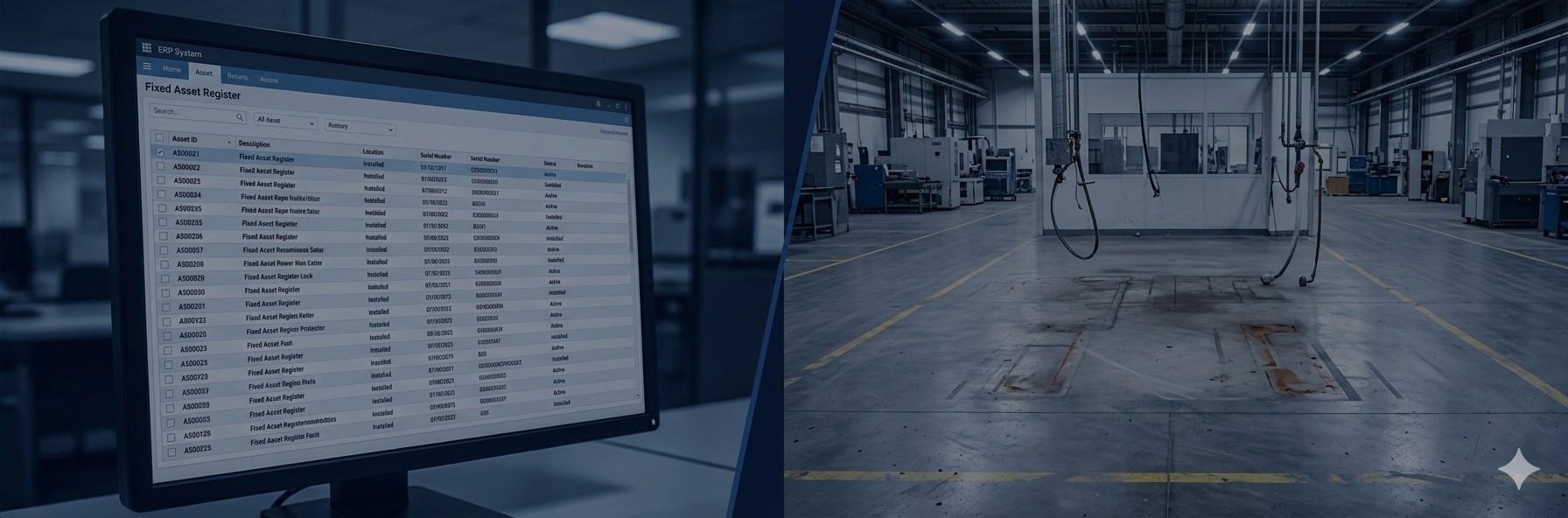
Most companies think their fixed asset problem is an accounting issue.
It is not. It is an evidence problem.
ERP systems were built to record what assets should exist. They capture transactions, depreciation schedules, and acquisition costs. What they cannot do is verify that the physical asset you are depreciating is still where it is supposed to be, still in the condition it is supposed to be in or still exists at all.
Assets move every day. They get retired, cannibalized for parts, replaced during shutdowns, or simply disappear from the floor. Your ERP records none of it until someone files a journal entry. Most of the time, nobody does.
That is the structural problem. It is not caused by sloppy bookkeeping. It is caused by a design constraint in the system itself.
What the ERP Can See
A fixed asset register is excellent at what it was designed to do. It tracks acquisition cost, depreciation method, useful life, and disposal when someone formally records one. For financial reporting and audit compliance, it is the system of record.
What it cannot do is see the physical world.
Your ERP does not know whether the forklift, compressor, pump, or production line it is depreciating still exists. It does not know if the asset was moved to a different facility, swapped out during a maintenance cycle, or scrapped three years ago without a work order. It only knows what it has been told.
This creates two categories of data error that compound over time.
The first is ghost assets. These are assets still on your books that no longer exist physically. They were retired, lost, stolen, or decommissioned, but no one ever filed the paperwork. Your system keeps depreciating them, and your balance sheet carries value for something that is not there.
The second is zombie assets. These are physical assets that exist on the floor but are missing from your register. Equipment was added during a capital project, moved in from another location, or donated. No one created the record. Your system has no visibility into them.
Kroll Advisory research found that 10 to 30 percent of fixed asset records at typical enterprises are ghosts. Up to 65 percent contain errors of some kind.
That range is wide because the severity depends on how actively a company manages its asset base. But even at the low end, that is a material problem for any asset-intensive business.
Why This Is Structural
The evidence gap does not happen because controllers are negligent. It happens because the process for keeping asset records current was never designed to work continuously.
The standard process looks like this. When a capital project closes, a capitalization team creates the asset record. After that, the maintenance team logs repairs and replacements, usually in a separate EAM system that does not write back to the fixed asset register. When an asset is disposed of, someone in accounting is supposed to record the retirement. When an asset is moved, someone is supposed to update the location.
Every one of those handoffs breaks constantly. Maintenance systems and financial systems do not share a common identifier for the same physical asset. Disposal paperwork gets filed late or not at all. Location moves happen informally during shutdowns. Controllers are focused on close and audit prep, not on chasing field records.
The result is a register that starts accurate and drifts every single day. Most companies catch the drift once a year, during the physical inventory. The rest of the year, they are operating on a record that is, at best, approximate.
Why This Matters Financially
The financial exposure is distributed across several line items, which is part of why it is easy to ignore.
Ghost assets inflate your depreciation expense every period. They overstate your gross asset value on the balance sheet. If your insurance is based on declared asset values, you are paying premiums on assets you do not own. When you go through an audit, your auditors are testing a population that includes records that do not correspond to physical assets.
For companies preparing for M&A, the problem is acute. A buyer will conduct a physical asset verification as part of due diligence. If your books show 5,000 assets and the physical count finds 3,800, you have a negotiating problem. The gap between what you claim and what actually exists is a direct line item in deal value.
At the regulatory level, the pressure is increasing. The PCAOB reports that long-lived asset audit deficiencies doubled between 2022 and 2024. CSRD and ESRS requirements are expanding what European companies must disclose about physical assets. The standard for what is acceptable documentation is moving, and the current state at most companies is not moving with it.
The cost is not a single line item. It is spread across depreciation, insurance, audit labor, and balance sheet accuracy. Add it up, and the number is significant.
In the next post, I will show what that full cost looks like when you add it up.
Why I Started Thinking About This Differently
SoloTruth started in a different part of this problem.
We built SoloTruth VirtuSpect to help SBA lenders verify the physical assets behind small business loans. The SBA requires that lenders document the existence and condition of collateral assets before closing. Most lenders were sending inspectors on-site, paying for physical visits, and waiting days for reports.
We replaced that process with a remote inspection platform. The core insight was not about software. It was about evidence. A lender does not need someone physically present in a building to verify that equipment exists. They need trustworthy, documented evidence of its existence and condition. The right technology can produce that evidence at lower cost, faster, and with a better audit trail.
That platform worked. Celtic Bank used it to verify assets for SBA loans and reduced loan closing time by approximately four days. The evidence we produced was sufficient to satisfy SBA SOP requirements.
While we were building it, I kept running into the same structural problem on the industrial side. Manufacturers and logistics companies were asking how to keep their fixed asset records current between audits. The gap between what their ERP said and what their floor actually contained was the same kind of problem we had solved for lenders. Different context, same evidence failure.
That realization led to SoloTruth ARM. The product is different. The underlying problem is identical: physical assets need trustworthy evidence, not just records.
The Implication
You do not just need a better ERP module. Better software for recording transactions does not solve a problem caused by the absence of physical verification.
You do not just need more frequent audits. A sample-based annual audit is a backward-looking snapshot. It tells you what was probably true at one point in time. It does not give you continuous visibility.
You do not just need better policies. Policy changes fail when the process that should generate the data does not exist or is not followed consistently. Telling field teams to be more diligent about paperwork has been the standard answer for thirty years. The gap is still there.
You need a continuous way to connect physical reality to financial truth. That is the gap SoloTruth is built to close.
What I Will Show Next
This post is about the problem. The technology stack that makes continuous asset verification practical has changed significantly in the last few years. In the next post, I will show what changed and why the solution is now buildable at a cost that makes sense for the businesses that need it most.