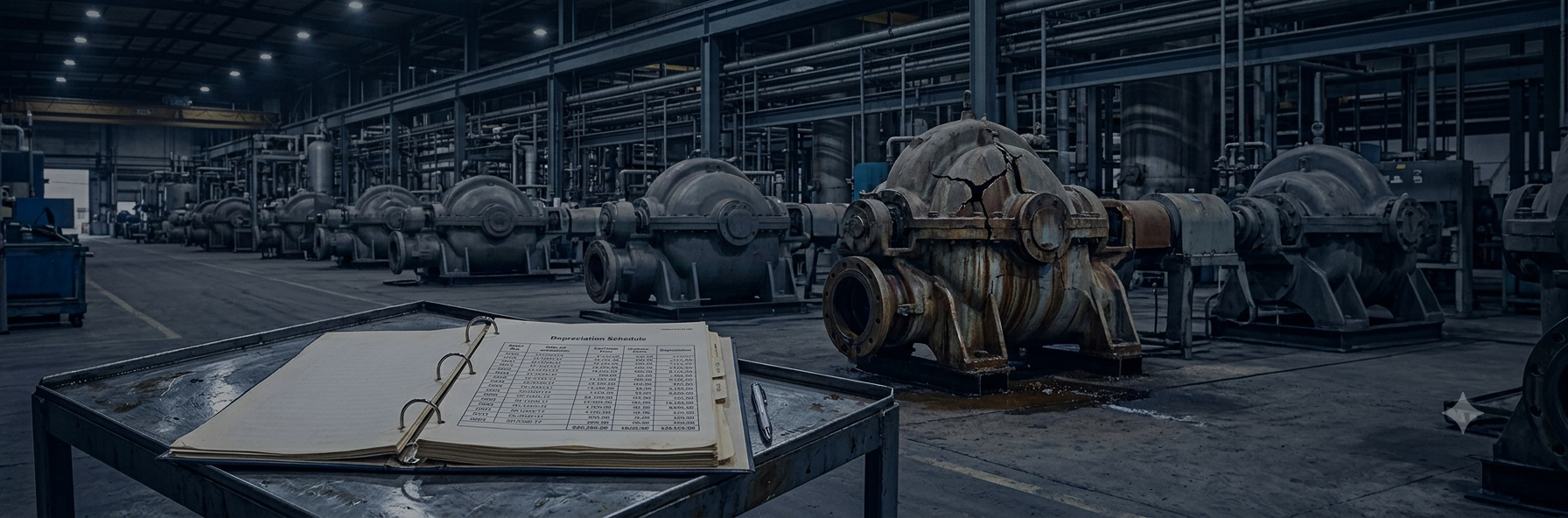
Asset condition verification is the ongoing practice of documenting where a fixed asset is and what physical state it is in, rather than confirming it once a year. That evidence feeds four separate financial decisions: whether an asset needs writing down, how long it will actually last, what depreciation to book, and what it costs to insure properly.
Most fixed asset programs get sold on one promise: a clean register. Find the ghost assets, retire them, reconcile the subledger, pass the audit. That work matters. Research from Kroll Advisory, drawing on more than 8,000 fixed asset engagements a year across 36 countries, puts ghost assets at 10 to 30 percent of the average fixed asset register.
A clean register is a snapshot. The decisions that depend on it are not. Controllers, fixed asset managers, and risk officers make four calls every year that rest on the physical condition and location of equipment, and all four assume somebody knows the current state. In a Marsh poll at a June 2026 webinar, 59 percent of risk and finance professionals said they were unsure when their assets were last independently valued, had not valued them recently, or were relying on estimated values.
What Asset Condition Data Actually Decides
Asset condition data is the documented physical state of an asset over time: damage, wear, obsolescence, relocation, and actual use. Four accounting and insurance decisions depend on it, and each one runs on a schedule that assumes the information is current.
The first is whether an asset needs to be written down. Under IFRS, IAS 36 names evidence of physical damage or obsolescence as an indicator that an asset may be impaired, which is the accounting term for recognizing that book value no longer reflects what the asset is actually worth. EY's March 2026 technical guidance states it plainly, and adds that if the entity now expects to abandon the asset earlier than planned, the depreciable period shortens too.
The second is useful life. IAS 16.51 requires residual values, useful lives, and depreciation methods to be reviewed at each financial year end and adjusted going forward when the evidence has changed. EY and KPMG both cite that section directly in their 2026 guidance. A review of an estimate is only as good as what you know at the time you review it.
The third is depreciation itself, which is downstream of the second. Change the useful life and you change the annual charge. KPMG's Singapore illustrative statements carry a single worked example of diesel trucks whose useful life was revised from an original eight years down to two remaining. That is one company's disclosure, not a benchmark, and the mechanism is the point rather than the number.
The fourth is insured value. Insurance is underwritten on declared values, and declared values come from the insured, not the broker.
Why Condition Data Goes Stale
Condition data decays for structural reasons, not because anyone is careless. Four causes account for most of it.
- The count is annual. The change is not. A physical inventory tells you what was true on the day it ran. Equipment gets damaged, relocated, cannibalized for parts, and quietly taken out of service in the eleven months nobody is looking.
- The ERP records transactions, not condition. A fixed asset subledger knows what was purchased, what was capitalized, and what depreciation schedule was assigned. It has no field that fills itself in when a motor seizes or a line gets derated.
- The people who know are not the people who file. Maintenance technicians observe condition every week. Their work orders close in a maintenance system. Nothing routes that observation to the controller who owns the useful life estimate.
- No one owns the trigger. An accounting review that depends on somebody reporting a physical fact will not happen if no process assigns that reporting to a role.
Annual Count vs. Continuous Verification
|
|
Annual physical count |
Continuous verification |
|
Frequency |
Once per year, point in time |
Ongoing, evidence captured as work happens |
|
What it captures |
Existence and location on count day |
Existence, location, and condition over time |
|
Useful life review input |
Last year's observation |
Current observation at review date |
|
Trigger detection |
Found at the next count, or at audit |
Found when the condition changes |
|
Insurance valuation input |
Cost basis and estimates |
Documented current state per asset |
The Real Cost of Stale Condition Data
The cost shows up in four places, and finance usually meets it after the fact rather than before.
- Late write-downs. A damaged or obsolete asset keeps depreciating on its original schedule until somebody notices. The correction lands in one period instead of tracking reality as it happened.
- Useful life estimates nobody revises. Assets run past their assumed life with no replacement plan, or get replaced early while book value remains.
- Insurance declared at the wrong value. Marsh reports a case where a multinational that self-declared asset values without a formal valuation was understated by roughly 35 percent, ahead of a multi-million-dollar claim the same year. In another Marsh case, a real estate company had 23 of 30 owned properties underinsured, several by more than 50 percent, with about $370 million of exposure identified and three properties simultaneously overinsured by up to 293 percent. These are individual named cases, not an industry average.
- Audit labor spent proving basics. The Manufacturers Alliance benchmarks annual external audit fees between $1.17 million and $6.74 million for mid-to-large manufacturers. A meaningful share goes to fixed asset testing that better evidence would shorten.
"If your ERP says an asset is worth $500K but it's been damaged for 18 months, you may have a mandatory impairment event you don't know about yet."
Tim Harris, CEO, SoloTruth
Who Is Most Affected
Exposure concentrates where capital equipment is heavy, distributed, or hard to inspect.
- Manufacturers with large equipment estates. Condition changes constantly on a production floor, and the people who see it first work in maintenance, not finance.
- CFOs and controllers at SEC registrants. At the 2025 AICPA and CIMA Conference on Current SEC and PCAOB Developments, Ella Karafiat, Professional Accounting Fellow in the SEC's Office of the Chief Accountant, said ASC 360 requires entities to continually evaluate the appropriateness of useful lives assigned to long-lived assets, and that staff does not view impairment recognition as an acceptable substitute for determining the appropriate useful life.
- Risk managers and insurance buyers. Declared values age quietly. Nobody discovers the gap until a claim tests it.
- Internal audit and compliance teams. Long-lived assets became the leading internal-control-over-financial-reporting deficiency area at large audit firms in 2024, even as overall PCAOB deficiency rates improved from 46 percent in 2023 to 39 percent in 2024. Fixed assets are the one area moving the wrong way while audit quality overall moves the right way.
What to Look For in a Verification Approach
Not every approach to asset verification produces evidence a finance team can actually use. Six capabilities separate the ones that do.
- Condition capture, not just existence. Confirming an asset is present answers one question. Recording its physical state answers the ones that drive write-downs and useful life.
- Continuous evidence rather than periodic snapshots. A review performed at year end needs information that is current at year end, not eleven months old.
- Multi-source evidence combining physical inspection, location data, photographs, and document extraction. Single-source verification leaves gaps an auditor will find.
- Orchestrated workflow governance that routes, delegates, escalates, and approves automatically, so evidence moves through a defined process without someone coordinating every step by hand.
- Direct ERP reconciliation so verified data reaches the subledger without manual journal entries or spreadsheet handoffs. Human error in the transfer step erases the value of the verification.
- Audit-ready output with a documented evidence chain per asset, including who observed what, when, and with what supporting material.
What Good Looks Like
Organizations that close this gap tend to run the same five practices.
- Treat condition as a reportable field. Assign it an owner, a capture method, and a review cadence, the same way any other load-bearing data field is governed.
- Route maintenance observations to finance. The technician who finds the damage should not be the last person who knows about it.
- Set verification scope by risk and materiality. High-value and high-movement assets earn more frequent attention than low-value fixtures.
- Bring current evidence to the year-end review. Walk into the useful life and residual value review with documented condition per asset class rather than last year's assumptions.
- Reconcile declared insurance values against the same evidence. The asset data supporting a depreciation schedule should support the insurance schedule too.
Common Misconceptions About Asset Condition and Verification
Three assumptions cause most of the damage.
Misconception: Compliance requires a full annual physical count
Reality: IAS 16, IRS Publication 946, and SOX control expectations call for risk-based, evidence-supported verification. None of them mandates a blanket annual count of every asset. Continuous verification answers that risk-based standard more directly than an annual sweep does.
Misconception: Useful life is set at acquisition and left alone
Reality: IAS 16.51 requires review at each financial year end, and SEC staff has stated that continual evaluation is the expectation under ASC 360. An estimate made once and never revisited is the thing both standards are written against.
Misconception: Insured values are the broker's responsibility
Reality: Declared values come from the insured. Marsh's own polling found 59 percent of risk and finance professionals unsure when their assets were last independently valued or relying on estimates, which is a data problem sitting on the customer's side of the relationship.
Frequently Asked Questions
What is asset condition data?
Asset condition data is documented evidence of an asset's physical state, including damage, wear, obsolescence, and location. It supports write-down decisions, useful life reviews, depreciation accuracy, and insurance valuation.
Does a physical change to an asset trigger an accounting review?
Yes. Under IAS 36, physical damage or obsolescence is an impairment indicator. Under US GAAP, ASC 360-10-35-21 names a significant adverse change in an asset's physical condition as a recoverability test triggering event.
How often should useful life be reviewed?
IAS 16.51 requires review at each financial year end, with prospective adjustment when evidence has changed. SEC staff has said ASC 360 calls for continual evaluation of useful lives rather than a single estimate at acquisition.
Is there a percentage of damage that triggers an impairment test?
No. Both IAS 36 and ASC 360 are principles-based and evidence-triggered. Neither standard sets a numeric degradation threshold, which is why documented condition evidence carries the weight instead.
How does asset condition affect insurance cost?
Insurers underwrite on declared values supplied by the insured. Outdated declared values produce underinsurance, overinsurance, or both at once across a portfolio, and a claim is usually where that gets discovered.
What is the difference between asset tracking and asset verification?
Tracking answers where an asset is. Verification produces evidence of existence, location, and condition that a third party can audit, which is what a financial decision or an insurance valuation actually requires.
Verification Is What Makes the Register Worth Having
A fixed asset register that is accurate on paper still leaves four financial decisions running on assumption: the write-down, the useful life, the depreciation charge, and the insured value. Each of those depends on someone knowing the current physical state of the asset, and the standards behind them assume that knowledge exists.
This is the gap SoloTruth Asset Relationship Management (ARM) was built to close. ARM orchestrates continuous inspection evidence, location signals, and document-derived attributes into a verified record that reconciles directly with the ERP subledger, so the condition data behind those decisions is current when the decision gets made.
Book a 30-minute strategy call at calendly.com/tim-harris-solotruth/30min to see how continuous verification changes what your fixed asset register is actually capable of.
Last Updated: September 2026